Date
Overview
Image
A downloadable PDF of this lesson is available below:
Document
Lesson_Actionable_Research.pdf
(3.02 MB)
This lesson pairs with an explainer article introducing the concept of actionable research. It will be helpful to first read the explainer article, available here, as this article builds foundational understanding of the topic. Additional resources on the topic are available here.
Actionable research is solutions-oriented environmental research that informs decisions, behaviors, and discourse outside academia. Many researchers may not understand the difference between actionable science and more common terms like “applied” or “basic” science. Also, most academic researchers are not trained in the practices and mindset needed to conduct effective actionable science or understand its ability to give their research real-world impact.
Assumed Prior Knowledge
Advanced undergraduates or graduate students studying environmental issues and systems.
Learning Objectives
- Define actionable science and relate it to concepts like basic research, applied science, and advocacy science
- Relate actionable science to the concept of research coproduction
- Illustrate the way in which actionable, solutions-oriented research typically requires cross-disciplinary collaborations and analysis of environmental and social systems.
- Practice the skill of identifying individuals or organizations that have an interest in research that can inform decisions.
Key Terms/Concepts
applied and basic science; advocacy science; co-production; stakeholders; decision makers; environmental and social systems
The “Hook” (suggestions for quickly engaging students)
-
-
Compare and contrast research paper titles below. Ask, which of these is mostly likely to be actionable? Example: Both of these papers are about water turbidity and seagrass abundance, but can you spot the difference? Answer: The first one is all about a problem. The second one has something about a solution (i.e., suggested by the word “preventable”)
Using modelling to predict impacts of sea level rise and increased turbidity on seagrass distributions in estuarine embayments (Davis et al. 2016)
Preventable fine sediment export from the Burdekin River catchment reduces coastal seagrass abundance and increases dugong mortality within the Townsville region of the Great Barrier Reef, Australia (Wooldridge 2017)
Teaching Assignments
This lesson includes two different assignments that can be completed across different class periods.
- Activity 1: Steps 1–5
- Activity 2: Steps 6–10
-
Activity 1: Actionable Research Design Assignment
Prior to Class: As preparation for the session, assign the following SESYNC readings:
-
In Class: Use the associated PowerPoint to discuss the purpose of and process of using causal diagrams. Explain how the use of causal diagrams ensures that research is designed to potentially inform decisions, behaviors, or discourse outside of academia.
DocumentActionable_Research_Lesson_Slides_1.pptx (5.67 MB) -
Group Work: Have the learners split into small teams. Have them identify a socio-environmental system and a key research focus or question, then work through at least half of the steps in the PowerPoint to develop a biophysical causal diagram.
-
As Homework: Over the next week, outside class, each team should complete all of the seven steps in the PowerPoint, resulting in multiple causal diagrams.
-
Next Class: When the class reconvenes, each team should present several of their causal diagrams, including the one that resulted in the identification of parties with interest in the socially relevant outcomes.
Image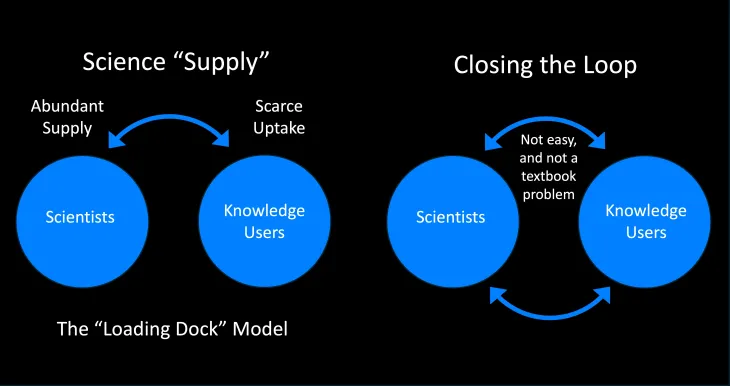
-
Activity 2: Identifying Actionable Research Needs Assignment
Note: The exercise could be elevated if the instructor identifies three or four “potential knowledge users” (i.e., managers, practitioners, natural resource decision makers, corporate sustainability officers) who are willing to talk with the trainees as part of the exercise. If that is done, the instructor should identify research themes to assign to groups so they will be complementary to the roster of knowledge users.Prior to Class: As preparation for the session, assign the following reading by Fisher et al. 2020.
-
In Class: Use the associated PowerPoint based on this article to explain/interactively discuss each step the authors propose for researchers to take to ensure they understand the research needs relevant to potential knowledge users.
DocumentActionable_Research_Lesson_Slides_2.pptx (942.51 KB) -
Group Work: Have the learners split into small teams to discuss their research interests and work through the very first part of Action Step A-1 (identify potential knowledge users or organizations).
-
As Homework: After class and on their own, each team should work to narrow the potential knowledge user to one believed to be the most relevant to their research interests. This process would involve searching the web and finding relevant resources to learn as much as they can about the potential user’s job, the surrounding issues, and the likely needs. They should prepare a short summary of what they expect those needs to include and why; and a written strategy for initiating a collegial and productive meeting with one of the potential users.
-
Next Class: When the class reconvenes, have the teams present their strategy to the rest of the participants to get feedback on their strategy.
-
Optional Extension: If the instructor has potential knowledge users identified, the teams should schedule a meeting with one of them and work their way through as many of the additional Action Steps in the Fisher et al. paper.
Background Information for the Instructor
-
What Is Actionable Research? Explainer
This brief SESYNC explainer article provides an overview of actionable, solutions-oriented research, including:
- Why it is not the same as “applied research” or “advocacy”
- Why it is broad and creative, requiring interdisciplinary approaches
- Examples of actionable research.
Boyd, J. (2022, March 1). Explainer – What Is Actionable Research? SESYNC. https://www.sesync.org/resources/explainer-what-actionable-research
-
A How-to Guide for Co-Production of Actionable Science
This guide discusses the role of co-production in actionable science and offers recommendations on practices intended to help scientists, managers, funders and other stakeholders carry out a co-production.
Beier, P., Hansen, L.J., Helbrecht, L. et al. (2017). A How-to Guide for Co-Production of Actionable Science. Conservation Letters, 10(3), 288–296. https://doi.org/10.1111/conl.12300
-
Linking Knowledge and Action for Sustainable Development
This article reviews approaches to the linkage of research knowledge and action and considers strategies to improve those linkages. It argues that the relationship between research-based knowledge and action should be understood as arenas of shared responsibility, embedded within larger systems of power and knowledge.
Van Kerkhoff, L., & Lebel, L. (2006). Linking Knowledge and Action for Sustainable Development. Annual Review of Environment and Resources, 31, 445–477. https://doi.org/10.1146/annurev.energy.31.102405.170850
-
Transcending the Loading Dock Paradigm—Rethinking Science-Practice Transfer and Implementation in Sustainable Land Management
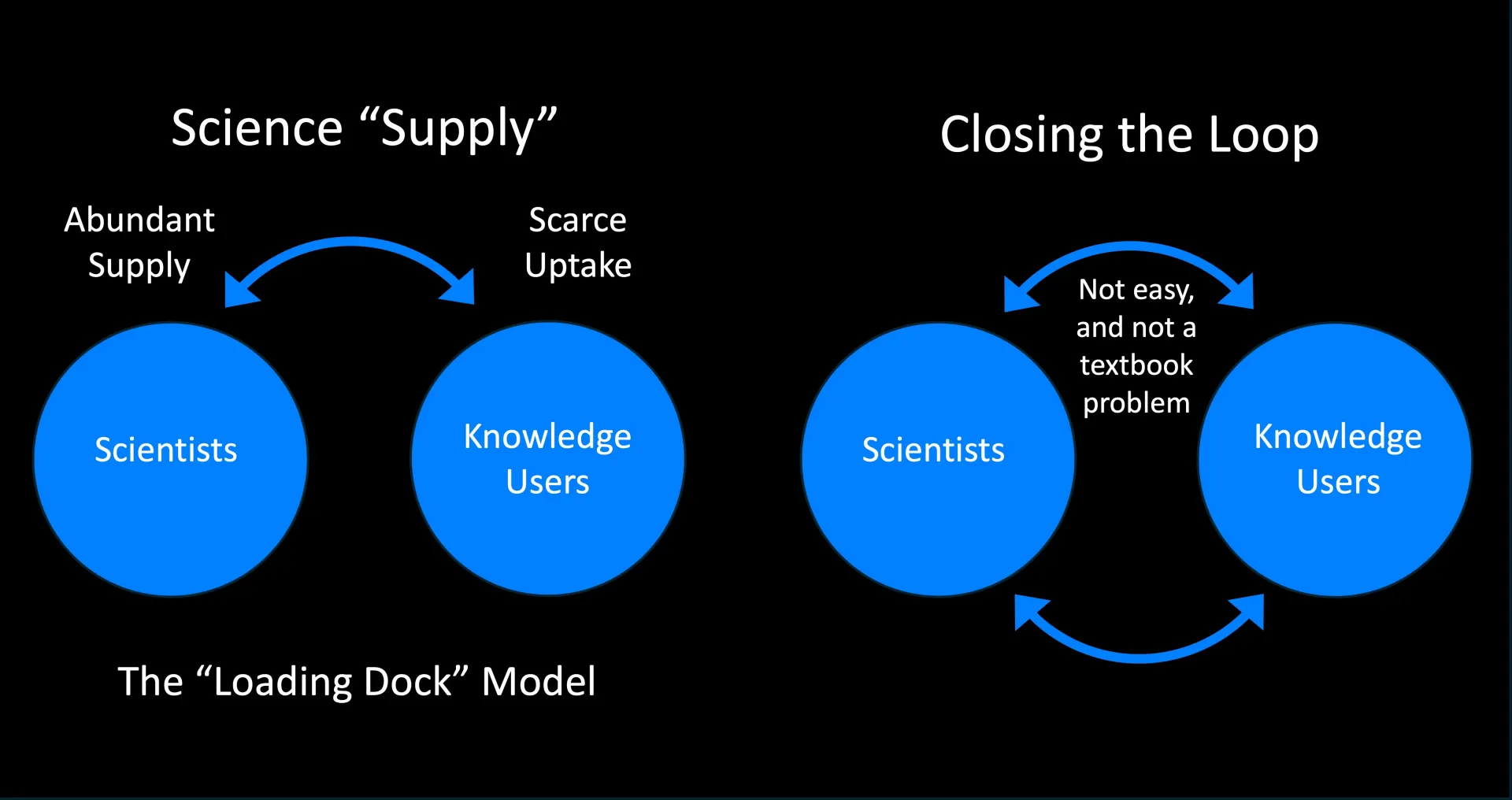
This chapter contrasts conventional research design and communication (the loading dock model) with the need to transcend disciplinary and institutional boundaries by actively engaging with non-academic actors. It argues that doing so allows for better problem-solving of real-world issues.
Rogga, S. (2021). Transcending the Loading Dock Paradigm—Rethinking Science-Practice Transfer and Implementation in Sustainable Land Management. In T. Weith, T. Barkmann, N. Gaasch et al. (Eds.), Sustainable Land Management in a European Context (pp. 249–265). Springer. https://doi.org/10.1007/978-3-030-50841-8_13
-
Science and Federal Environmental Decisions: A Survey of Interactions, Successes, and Difficulties
Using information gathered by interviewing federal employees, the authors identify a range of features and practices that contribute to the success or failure of decision-oriented scientific input. This study also holds lessons for science-oriented federal partners.
Boyd, J., & Kramer. J.G. (2017). Science and Federal Environmental Decisions: A Survey of Interactions, Successes, and Difficulties. Resources for the Future and the National Socio- Environmental Synthesis Center. https://media.rff.org/archive/files/document/file/RFF-DP-17-02.pdf
Share