Date
Description
Image

A downloadable version of this explainer is available here:
Document
Explainer_What_Is_Socio-Hydrology.pdf
(11.18 MB)
This brief explainer article goes over the basics of the topic of socio-hydrology, including:
- The origins of the concept
- Its distinction from similar fields
- Relevant research questions.
Background
In 2012, researcher Murugesu Sivapalan first used the phrase “socio-hydrology” in a journal article (Sivapalan, Savenije, & Blöschl 2012). He argued that because humans are part of environmental systems and not just drivers of change, our approach to water resource problems required rethinking. He called socio-hydrology a new science of coupled human-water systems and argued it required interdisciplinary, use-inspired work between hydrologists and social scientists that would benefit managers. He also viewed socio-hydrological systems within the broader context of socio-environmental systems to emphasize socio-hydrology’s connection to issues of land use and management, energy consumption, aquatic extractive uses like fisheries, and the various social interactions associated with each. Other scholars have objected to the claim that this is a new field because an extensive body of very similar water resource research may be couched simply under the rubric of socio-environmental or socio-ecological systems (Gunderson et al. 2017; D’Odorico et al. 2019), water governance (Pahl-Wostl 2017; Cosens & Gunderson 2018), or what is called hydro-social research, which comes primarily from the intersection of political ecology with science and technology studies.
Regardless of the phrase that is used, socio-hydrological research is distinct from the voluminous amount of work on how the physical aspects of water and water systems relate to human demand. That work dates very far back in time and continues today often under the areas of water engineering, water management, or water systems design. Unlike socio-hydrology, this particular area of research generally focuses on solving problems related to getting water where and when it is needed by humans. Examples include work on water reuse, water storage, water availability given climate change, and flood risk, based on physical location in the context of sea level rise. Socio-hydrology also should not be confused with ecohydrology, which refers to the interaction of hydrology and ecological systems—especially the partitioning of water between the atmosphere, plants, soils, and surface and ground water.
Image
The Fundamentals
A socio-hydrological study views the human-environmental system as being fully intertwined and must be studied as such. The system is conceptualized in terms of social and biophysical drivers, interactions, and feedbacks. Put simply, socio-hydrology is focused on understanding linked human-water dynamics. Through interactions, the social and physical components evolve over time in sustainable or unsustainable ways. Researchers particularly focus on social and biophysical interactions (Di Baldassarre et al. 2015), especially those that are cross-scale (York, Sullivan, & Bausch 2019).
Examples of Socio-Hydrology Research Questions:
- How does the relationship with water evolve across different societies and settings?
- What is the relationship between social vulnerability, adaptive capacity, and changes in flood/drought risk?
- What processes, feedbacks, and constraints can “trap” communities in unsustainable relationships with water resources?
- What types of water governance structures best help balance human and ecosystem needs?
- How do issues of gender interact with water resources?
- What are the social implications of expanding virtual water markets?
- How does the global economy, trade, or power influence those markets?
References:
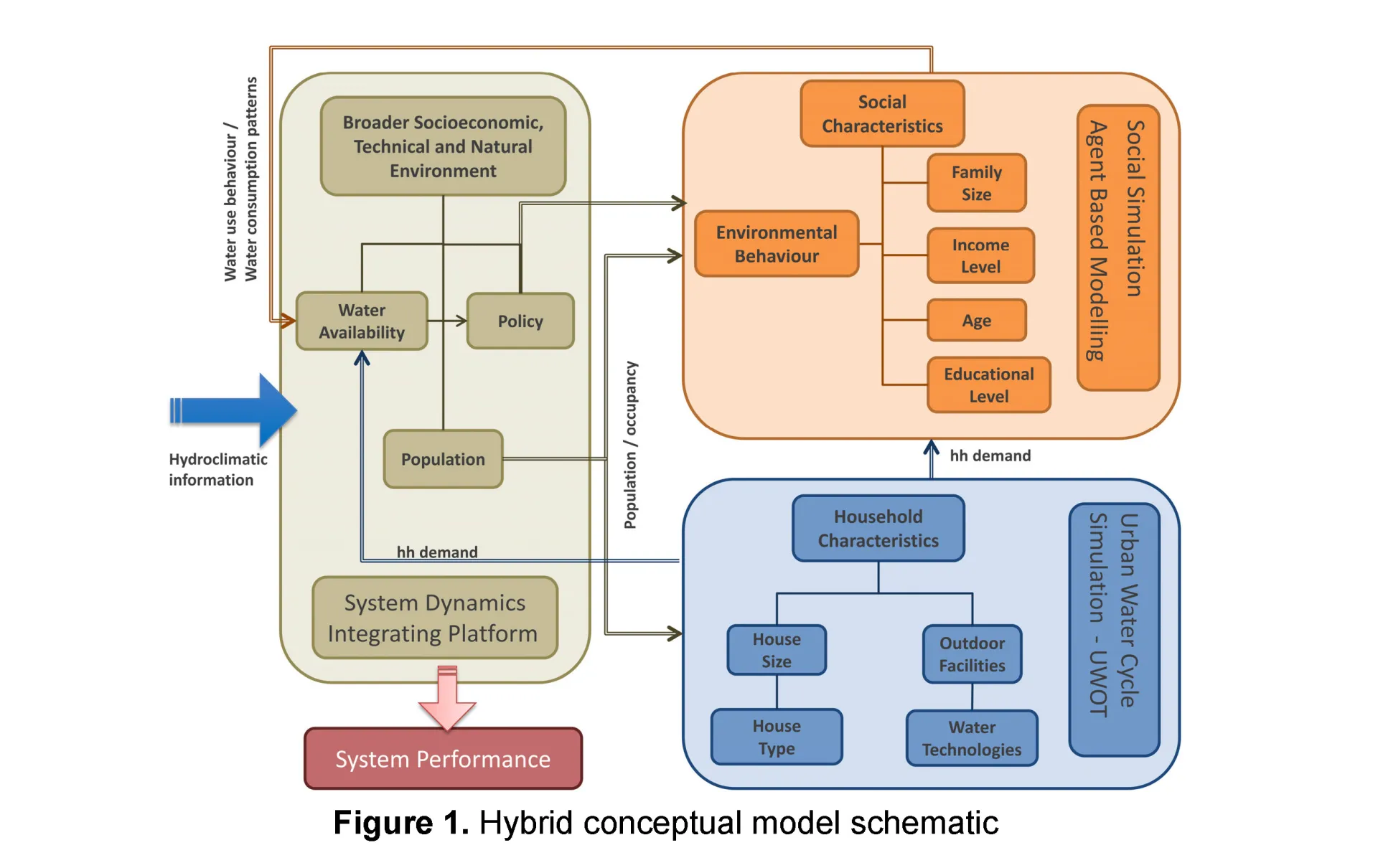
- Baki, S., Koutiva, I., Makropoulos, C. (2012). A hybrid artificial intelligence modelling framework for the simulation of the complete, socio-technical, urban water system. International Congress on Environmental Modelling and Software, 54(4). https://scholarsarchive. byu.edu/iemssconference/2012/Stream-B/54/
- Cosens, B., & Gunderson, L. (Eds.). (2018). Practical panarchy for adaptive water governance: Linking law to social-ecological resilience. Springer. https://doi.org/10.1007/978-3-319-72472-0
- Di Baldassarre, G., Viglione, A., Carr, G. et al. (2015). Debates— Perspectives on socio-hydrology: Capturing feedbacks between physical and social processes. Water Resources Research, 51(6), 4770-4781. https://doi.org/10.1002/2014WR016416
- D’Odorico, P., Carr, J., Dalin, C. et al. (2019). Global virtual water trade and the hydrological cycle: patterns, drivers, and socio-environmental impacts. Environmental Research Letters, 14(5), 053001 https://doi.org/10.1088/1748-9326/ab05f4
- Gunderson, L., Cosens, B.A., Chaffin, B.C. et al. (2017). Regime shifts and panarchies in regional scale social-ecological water systems. Ecology and Society, 22(1), 31. https://doi.org/10.5751/ES-08879-220131
- Madani, K., & Shafiee-Jood, M. (2020). Socio-Hydrology: A New Understanding to Unite or a New Science to Divide? Water, 12(7), 1941. https://doi.org/10.3390/w12071941
- Pahl-Wostl, C. (2017). An Evolutionary Perspective on Water Governance: From Understanding to Transformation. Water Resources Management, 31, 2917–32. https://doi.org/10.1007/s11269-017-1727-1
- Ross, A., & Chang, H. (2020). Socio-hydrology with hydrosocial theory: two sides of the same coin? Hydrological Sciences Journal, 65(9), 1443-57. https://doi.org/10.1080/02626667.2020.1761023
- Sivapalan, M., Savenije, H.H.G., & Blöschl, G. (2012). Socio-hydrology: A new science of people and water. Hydrological Processes, 26(8), 1270–1276. https://doi.org/10.1002/hyp.8426
- York, A.M., Sullivan, A., & Bausch, J.C. (2019). Cross-scale interactions of socio-hydrological subsystems: examining the frontier of common pool resource governance in Arizona. Environmental Research Letters, 14(12). https://doi.org/10.1088/1748-9326/ab51be
Share